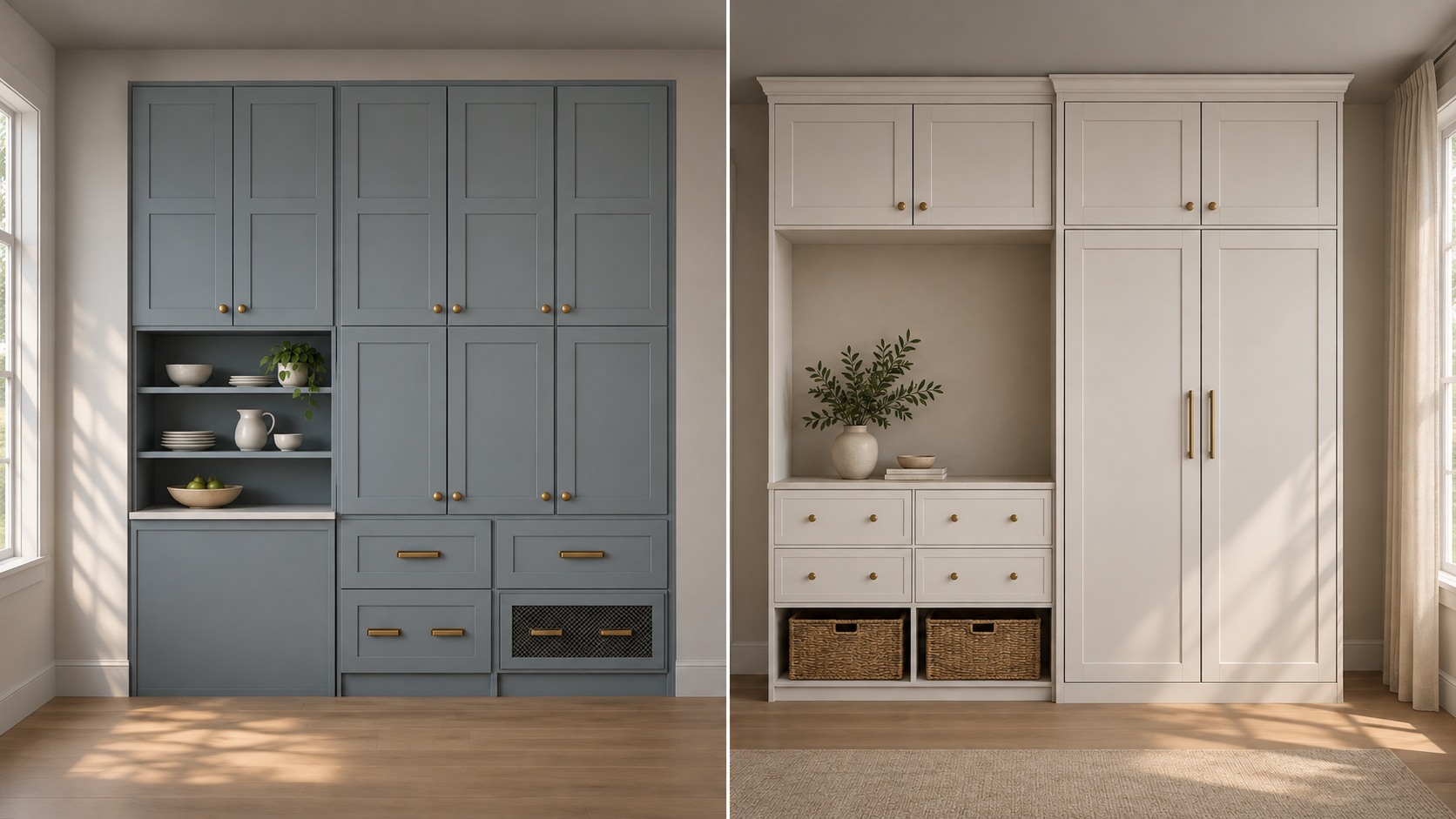

Cabinet door styles have a greater effect on the character of a kitchen than almost any other visible cabinet component. The profile determines whether the room feels crisp and minimal, warm and transitional, or detailed and traditional—even when the cabinet layout and paint colour remain the same. Homeowners, contractors, designers, and cabinet shops can begin by exploring Miter5’s collection of custom cabinet doors in Toronto, then compare how each profile will work with the scale, hardware, finishes, and daily demands of the space.
A successful choice must work on narrow drawer fronts, tall pantry doors, corner cabinets, vanities, built-ins, and the smaller components that complete a full cabinetry package. This guide explains the practical differences between slab, shaker, thin shaker, grooved, and dimensional recessed-panel designs so you can evaluate the whole project.

Why the Cabinet-Door Profile Matters
Cabinet doors occupy most of the visible surface area in a kitchen. Their rails, stiles, panels, grooves, and edge transitions create repeated lines across every wall of cabinetry. A small change in frame width can therefore make the room feel noticeably lighter or heavier. Narrow frames introduce more open panel area and cleaner geometry, while broad frames give each door greater visual weight.
The profile also affects how the eye reads the size of the room. Smooth slab doors reduce visual interruption and can make a compact kitchen appear calmer. Framed doors add rhythm and definition, which can be useful in a large kitchen that needs architectural structure. Detailed profiles create shadow lines and depth, but those details should be balanced against backsplash movement, countertop veining, decorative hardware, and other finishes.
What Separates One Cabinet Door Style From Another?
Most cabinet doors can be understood by looking at five practical features: construction, frame proportion, panel treatment, edge detail, and finish. Slab doors rely on an uninterrupted face. Shaker and recessed-panel doors use a framed composition. Grooved slab designs sit between those categories by retaining a flat face while adding routed architectural lines.
- Frame width: Narrow rails and stiles look lighter; broad framing appears more substantial.
- Panel depth: A deeper recess produces stronger shadow lines and a more dimensional appearance.
- Corner treatment: Square corners feel crisp, while rounded transitions soften the profile.
- Decorative detail: Grooves, bevels, and raised inner borders add character but also increase visual activity.
- Drawer-front strategy: The design must remain balanced when scaled down from a tall door to a shallow drawer front.
Traditional Shaker Cabinet Doors
The classic shaker door is popular because its frame-and-panel arrangement is easy to understand and works with many interiors. Wide rails and stiles define the perimeter, while a recessed centre panel keeps the design from becoming too ornate. It can support farmhouse, transitional, traditional, and relaxed contemporary kitchens depending on the colour, hardware, and surrounding millwork.
Traditional shaker proportions work especially well on medium and large doors. On shallow drawer fronts, broad frames can leave little centre-panel area, so the drawer design and hardware scale should be reviewed rather than simply reduced from the door proportions.
Thin Shaker Cabinet Door Styles for a Lighter Look
Thin shaker doors retain the familiar recessed-panel composition but reduce the width of the perimeter frame. The result is a more contemporary profile with a larger centre panel and less visual weight. This is useful in kitchens with tall pantry doors, long runs of cabinetry, or compact rooms where a standard shaker frame may feel too dominant.
Miter5’s Palmerston thin shaker profile uses narrow 3/4-inch rails and stiles, square corners, and a recessed centre panel. The crisp geometry works well with modern and transitional interiors, and the narrow frame can be carried across doors and matching drawer fronts without the cabinet faces becoming overly busy.

Smooth Slab Doors for Modern and Minimalist Kitchens
A slab door removes the framed border and presents one continuous surface. That simplicity makes it a natural choice for modern kitchens, but it also works in closets, vanities, home offices, wall units, and built-ins where the goal is to reduce visual noise. Slab doors allow material, colour, lighting, and hardware to take a more prominent role.
The Mercer smooth slab cabinet door has no grooves, raised panels, or decorative frame details. Its uninterrupted face is easy to wipe clean and works particularly well with long linear pulls, edge pulls, or carefully planned handle-free systems. Because the door is visually quiet, alignment becomes especially important: inconsistent gaps or poorly positioned hardware are more noticeable on a simple slab elevation.

Grooved and Architectural Slab Doors
Some clients like the clean surface of a slab door but want a stronger design signature. Routed grooves can introduce vertical rhythm without using a full rail-and-stile frame. This approach works well when the cabinetry should remain contemporary but needs more character than a completely plain slab.
The Aria grooved slab design uses distinctive vertical routed details along the face. Those lines can emphasize height on pantry doors and create a repeated architectural feature across a run of cabinetry. Because the detailing is directional, the placement and consistency of grooves across doors and drawer fronts should be planned carefully. The profile should appear intentional rather than randomly applied to components of different widths.
Detailed and Recessed-Panel Cabinet Doors
Dimensional recessed-panel doors use more than a basic frame and flat centre panel. Bevels, stepped transitions, or raised inner borders create additional shadow lines. These profiles can give a kitchen a more tailored appearance and are especially useful in larger rooms where plain doors may not provide enough architectural presence.
The key is restraint. Detailed doors already contribute movement, so countertops, backsplashes, and hardware should support rather than compete with them. A refined profile paired with simple hardware can feel transitional and current; the same door with ornate pulls and highly patterned stone may read as more traditional.

Choosing Between Modern, Transitional, and Traditional Styles
Modern kitchens usually benefit from simplified geometry: slab doors, thin shaker profiles, and restrained grooved details. Transitional kitchens bridge clean contemporary lines with enough frame or panel detail to add warmth. Traditional rooms can support broader frames, deeper recesses, and more pronounced inner profiles.
The architecture of the home should guide the decision without controlling it. A traditional Toronto house can feel fresh with thin shaker cabinetry, while a modern condominium can gain warmth from a restrained recessed-panel door. Choose the profile alongside the flooring, trim, countertop, backsplash, and hardware rather than in isolation.
Match the Door Profile to the Kitchen Layout
Before approving a profile, review it at the sizes that will actually appear in the kitchen. A design that looks balanced on a 30-inch-tall door may become crowded on a shallow drawer front. Wide frames reduce the remaining panel area, while routed details may need enough width to avoid colliding with hardware or door edges.
Tall pantry doors magnify every line in the profile. Thin shaker frames can emphasize height without becoming heavy, while slab doors create broad uninterrupted planes. On an island with many drawers, consistency may matter more than ornament. A strong kitchen design often uses one door family but adjusts drawer-front treatment thoughtfully so the entire elevation feels related and proportionate.
Choosing Colours and Painted Finishes
Colour changes the way a profile reads. Light finishes soften shadow lines and make detailed doors feel quieter. Dark finishes increase contrast inside grooves, bevels, and recessed panels, making the machining more visible. Muted greens, blue-greens, warm grays, and beige tones can add personality while remaining flexible with stone and wood finishes.
The eight colour swatches displayed on Miter5 product pages are intended as useful previews across a representative range of finishes. They are not the complete colour offering. Customers are not limited to those eight examples; Miter5 cabinet doors can be produced in virtually any custom paint colour. A physical paint sample should always be used for final approval because screens, lighting, sheen, and surrounding materials can alter how a colour appears.

Custom Sizes for Refacing and Replacement Projects
When cabinet boxes remain solid and the layout still works, replacing doors and drawer fronts can update the room without removing the entire cabinet system. The process depends on accurate measurements, consistent reveals, hinge planning, and a door profile that suits the existing openings. Standard retail dimensions are often inadequate in older kitchens or custom-built cabinetry.
Made-to-order doors can also be used to match a vanity, repair a damaged section, complete a new island, or update built-ins and closets. For profile matching, a sample door is ideal, but clear photographs, drawings, and measurements can also help determine whether an existing Miter5 style is suitable or whether a custom variation is required.
Why HDF Is Commonly Used for Painted Cabinet Doors
Painted cabinet doors require a material that machines cleanly, accepts primer and paint evenly, and allows routed details to remain consistent from one component to the next. High-density fibreboard is well suited to one-piece painted door profiles because it provides a smooth, uniform surface without the grain movement and joint lines associated with some solid-wood constructions.
West Fraser describes medium-density fibreboard products as engineered wood panels used for cabinetry, furniture, shelving, fixtures, and interior millwork, with surfaces that can be machined, shaped, sanded, routed, primed, and painted. Material selection still needs to match the application, and finished doors should be protected from standing water and excessive moisture just like other painted interior millwork.
Made-to-Order Cabinet Doors in Toronto and the GTA
Miter5 manufactures cabinet doors and drawer fronts locally in Canada for homeowners, contractors, designers, and cabinet shops across Toronto and the GTA. Orders can range from a single replacement door to a full package for a kitchen, vanity, closet, laundry room, wall unit, or built-in.
Made-to-order production allows each project to be reviewed by profile, size, quantity, application, and finish instead of being limited to stock dimensions. Doors and drawer fronts can therefore be coordinated across unusual openings, refacing work, custom millwork, and new cabinetry.
How to Compare Five Miter5 Cabinet-Door Profiles
Mercer — Smooth Slab
A flat, uninterrupted face without grooves, raised panels, or frame details. Mercer is best suited to minimalist and modern cabinetry, especially kitchens, closets, pantries, vanities, and built-ins where clean alignment is the priority.
View the Mercer cabinet doorPalmerston — Thin Shaker
Narrow 3/4-inch rails and stiles, square corners, and a recessed centre panel give Palmerston the familiarity of shaker cabinetry with a lighter architectural frame. It suits modern and transitional kitchens, vanities, closets, and wall units.
Explore the Palmerston thin shaker styleAria — Grooved Slab
Aria starts with a clean slab-style surface and adds distinctive vertical routed detailing. The profile provides more architectural interest than a plain slab while remaining appropriate for contemporary kitchens, built-ins, closets, and feature cabinetry.
See the Aria architectural groove detailSeaton — Dimensional Panel
A broad outer frame and narrower raised inner border surround the recessed centre panel. Seaton offers layered depth and balanced shadow lines for refined transitional kitchens, vanities, built-ins, closets, and custom millwork.
Review the Seaton recessed-panel profilePalmetto — Stepped Bevel
Broad rails and stiles frame a recessed panel with a stepped inner bevel. Palmetto has more visual presence than a basic shaker door and works well in transitional or refined contemporary rooms that need additional depth.
Compare the Palmetto stepped profileChoose Cabinet Door Styles as Part of the Whole Kitchen
The best cabinet door styles are not chosen by trend alone. They balance the architecture of the home, the proportions of the cabinet layout, the size of doors and drawer fronts, the amount of decorative detail in the room, and the practical demands of everyday use. A smooth slab can create calm, a thin shaker can add light structure, and a detailed recessed-panel profile can bring depth to a larger or more transitional space.
Compare profiles at realistic sizes, view them in more than one colour, and consider how the design will repeat across the full project. Miter5 can manufacture painted HDF doors and matching drawer fronts in custom sizes and virtually any custom colour for new cabinetry, refacing, replacements, and custom millwork throughout Toronto and the GTA.
Frequently Asked Questions
What cabinet-door style is easiest to maintain?
A smooth slab door is generally the easiest to wipe down because it has no recessed corners or profile edges where grease and dust can collect. Thin shaker doors are also straightforward to maintain, but the inside frame should be cleaned periodically. More detailed recessed-panel profiles require a little more attention around bevels and inner borders.
Can cabinet doors be made in custom sizes?
Yes. Miter5 manufactures cabinet doors and matching drawer fronts to the dimensions required for the project. Custom sizing is useful for older kitchens, non-standard cabinet boxes, built-ins, vanities, closets, refacing projects, and new custom cabinetry where stock sizes do not fit.
Can Miter5 match an existing cabinet-door profile?
Miter5 can review an existing sample door, clear photographs, drawings, or detailed profile measurements. The information is used to determine whether a catalogue profile is a close match or whether a modified or custom profile should be developed for the project.
Are customers limited to the eight displayed colours?
No. The eight swatches on the product pages are preview examples that show how a profile changes across several popular light, neutral, green, blue-green, and dark finishes. Miter5 cabinet doors can be produced in virtually any custom paint colour, subject to final colour confirmation.
What is the difference between slab and shaker cabinet doors?
A slab door has a flat, uninterrupted face and creates a clean modern appearance. A shaker door uses a framed look with rails and stiles surrounding a recessed centre panel. Thin shaker designs reduce the frame width for a lighter, more contemporary version of the classic shaker profile.
Can replacement doors be ordered without replacing the cabinet boxes?
Yes. When cabinet boxes are structurally sound and the existing layout still works, new doors and drawer fronts can be ordered for a refacing or replacement project. Accurate measurements, hinge planning, finish selection, and consistent drawer-front proportions are important for a professional result.